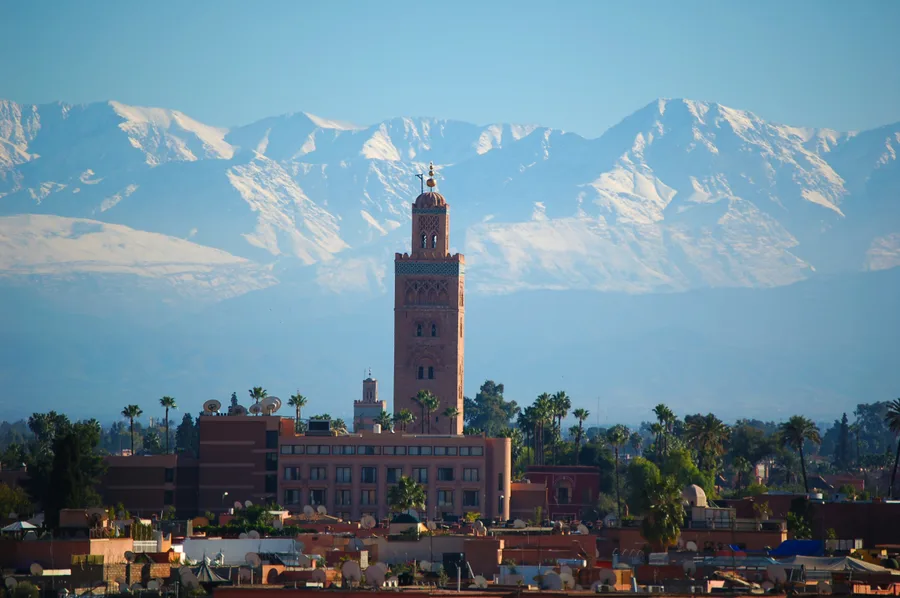
Marrakech—known universally as the Red City (Al-Hamra) for its beaten-clay ramparts and ochre-washed architecture—is a sensory wonderland where medieval North African traditions harmonize with contemporary cosmopolitan luxury. Whether you are stepping through the carved cedar gates of 14th-century madrasas or sipping spiced mint tea as dusk settles over the high Atlas peaks, Marrakech rewards curious, open-minded travellers at every turn.
[!NOTE] Marrakech Attractions Quick-Facts & Visitor Logistics (2026)
- Standard State Monument Admission: 70 MAD (~€6.50) each for Bahia Palace, Badi Palace, and the Saadian Tombs.
- Ben Youssef Madrasa: 50 MAD (~€4.50) admission; open daily 09:00 to 18:00.
- Jardin Majorelle: 150 MAD (~€14.00); mandatory advance online reservation with strict timed entry slots via their official ticketing portal.
- Medina Navigation: The ancient walled city is entirely car-free; download offline map applications (Google Maps Offline or Organic Maps) before heading into the labyrinthine alleys.
- Getting Around the City: Use cream-coloured Petit Taxis within the city (always insist on the meter / compteur) or pre-book a KechGo private transfer for fixed-price, hassle-free airport pickups and excursion transport.
Marrakech Highlights Matrix: Essential Attractions at a Glance
| Attraction | District | Entry Fee (MAD / EUR) | Opening Hours | Best Time to Visit | Essential Tip |
|---|---|---|---|---|---|
| Ben Youssef Madrasa | Northern Medina | 50 MAD (€4.50) | 09:00 – 18:00 | 09:00 (Opening) | Arrive first thing in the morning to photograph the courtyard empty. |
| Bahia Palace | Mellah / Southern Medina | 70 MAD (€6.50) | 09:00 – 17:00 | Early morning or 15:30 | Look upward: the carved cedar wood ceilings are the finest in Morocco. |
| Jardin Majorelle | Guéliz / Majorelle | 150 MAD (€14.00) | 08:30 – 18:00 | 08:30 slot | Tickets are never sold at the gate; book online 3 to 7 days ahead. |
| Badi Palace | Kasbah | 70 MAD (€6.50) | 09:00 – 17:00 | Late afternoon | Climb the ramparts for panoramic views of nesting storks and Atlas mountains. |
| Saadian Tombs | Kasbah | 70 MAD (€6.50) | 09:00 – 17:00 | 09:00 – 10:00 | The Chamber of the Twelve Pillars can develop a 30-minute queue by noon. |
| Le Jardin Secret | Central Medina (Mouassine) | 100 MAD (€9.50) | 09:30 – 18:30 | Midday retreat | Climb the private tower for an aerial view over Medina rooftops. |
| Jemaa el-Fna | Medina Gateway | Free (Open Square) | 24 Hours (Peak 18:00) | Sunset / Dusk | Grab a front-row balcony seat at Café de France for sunset photography. |
Historic Palaces, Madrasas & Sacred Architecture
1. Stand in Awe at the Ben Youssef Madrasa
Founded in the 14th century by Sultan Abu al-Hasan and expanded in the 1560s by the Saadian dynasty, this Quranic college was once the largest Islamic school in North Africa, housing over 900 theological students.
- The Architecture: The central courtyard is paved in Italian Carrara marble, surrounded by walls covered in intricate geometric zellij tilework, carved stucco lace calligraphy, and heavy Atlas cedar eaves.
- Visitor Tip: Walk up to the second floor to explore the tiny, austere student dormitory cells (qubbas), peering through carved wooden mashrabiya lattices into the central reflecting pool below.
2. Wander the Stately Courtyards of Bahia Palace
Spanning nearly eight hectares, the 19th-century Palais de la Bahia (“Palace of the Brilliant”) was constructed for Grand Vizier Si Moussa and later expanded by his son, Ba Ahmed.
- Highlights: The Grand Courtyard (Cour d’Honneur), an expansive open esplanade tiled in pristine white and golden-yellow marble, shaded by aromatic bitter orange trees.
- Local Insight: Notice how doorways between apartments are intentionally low and staggered; this was engineered so couriers had to bow their heads upon entering, preserving the visual privacy of the Grand Vizier’s wives and concubines.
3. Contemplate the Ruins of Badi Palace (Palais El Badi)
Commissioned by Saadian Sultan Ahmad al-Mansur following his decisive victory over the Portuguese at the Battle of the Three Kings in 1578, El Badi (“The Incomparable”) was financed with European ransom gold and paved with Italian marble, ivory, and onyx.
- Although stripped of its precious stones by Alaouite Sultan Moulay Ismail a century later, the massive sunken orange orchards, subterranean prison tunnels, and monumental rammed-earth pisé walls remain deeply awe-inspiring.
- Dozens of white storks (Ciconia ciconia) build colossal stick nests atop the palace battlements year-round.
4. Marvel at the Chamber of the Twelve Pillars in the Saadian Tombs
Sealed behind high walls for over two centuries until rediscovered by aerial photography in 1917, the Saadian Tombs are the final resting place of Sultan Ahmad al-Mansur and his royal family.
- The Centerpiece: The mausoleum of the Sultan features the Chamber of the Twelve Pillars, supported by columns of flawless Carrara marble supporting vaulted ceilings carved from gilded honeycomb cedar (muqarnas).
- Photography Advice: Arrive right at 09:00. The viewing portal to the central chamber is narrow, and during midday peak hours visitors must wait in a single-file line under the sun.
5. Admire the Landmark Koutoubia Mosque & Gardens
The minaret of the 12th-century Koutoubia Mosque rises 77 meters above the Marrakech plain, establishing the legal height limit for all architecture in the city. Its proportions, pointed horseshoe arches, and decorative ceramic banding served as the architectural prototype for the Giralda in Seville and the Hassan Tower in Rabat.
- While the interior prayer hall is reserved exclusively for Muslim worshippers, the surrounding rose gardens, orange groves, and excavated foundations of the original Almoravid mosque are free to stroll day and night.
Enchanting Botanical Gardens & Green Sanctuaries
+-------------------------------------------------------------------------------+
|                       MARRAKECH'S GARDEN OASIS TRAIL                         |
|                                                                               |
|  [Jardin Majorelle]  ───(5 min walk)───>  [Yves Saint Laurent Museum]         |
|     (Cobalt Blue Villa & Giant Cacti)       (Haute Couture & Berber Jewelry)  |
|                                                                               |
|  ───(10 min taxi)───>  [Le Jardin Secret]  ───(15 min taxi)───> [Menara]     |
|    (Restored Medina Riad & Tower)            (Historic Olive Basin & Pavilion)|
+-------------------------------------------------------------------------------+
6. Immerse Yourself in Cobalt Blue at Jardin Majorelle
Created over four decades by French Orientalist painter Jacques Majorelle and later rescued from commercial demolition by fashion icon Yves Saint Laurent and Pierre Bergé, this botanical sanctuary is Marrakech’s most famous attraction.
- The Aesthetic: Towering desert cacti, weeping bamboos, and broad-leaf water lilies create a living tapestry framed against electric Majorelle Blue (Bleu Majorelle) and canary-yellow architectural accents.
- Critical Booking Rule: Tickets are sold strictly online. You cannot buy a ticket at the entrance turnstiles. Visit the official foundation ticketing website at least 3 to 5 days prior to secure your preferred morning time-slot.
7. Step into Tranquility at Le Jardin Secret
Tucked behind unassuming mud-brick walls in the Mouassine quarter of the Medina, Le Jardin Secret is a restored 19th-century palace complex divided into two magnificent courtyards:
- The Exotic Garden: Planted with flora collected from six continents, including rare succulents, Australian cycads, and Madagascar palms.
- The Islamic Garden: A rigorous geometrical reconstruction of the Quranic Paradise garden, divided into four quadrants by water channels supplied by the ancient khattara underground aqueduct system.
- Stop at the second-story café overlooking the gardens for fresh mint iced tea and homemade almond gazelle horns (cornes de gazelle).
8. Sunset Stroll by the Historic Menara Gardens
Dating back to the 12th century under the Almohad Caliphate, the Menara Gardens encompass over 100 hectares of productive olive orchards surrounding a colossal central water basin. The 19th-century green-tiled Saadian pleasure pavilion against the backdrop of snow-capped High Atlas peaks is Morocco’s most iconic postcard view. Entry to the olive gardens is free; pavilion entrance is 70 MAD.
9. Wander the Surrealist Art Trail at ANIMA Garden
Located 28 km south of Marrakech in the Ourika valley foothills, ANIMA Garden was created by Austrian multimedia artist André Heller. It is a fantastical fusion of botanical paradise and contemporary sculpture, featuring shaded trails woven between colossal weeping willows, giant glass heads, mosaic eyes, and sculptures by Keith Haring and Auguste Rodin.
- A complimentary shuttle bus runs twice daily between the Koutoubia parking in Marrakech and ANIMA.
10. Digital Detox at Cyber Park (Arsat Moulay Abdeslam)
Situated conveniently between the Medina and Guéliz, this historic 18th-century royal botanical garden was restored into a public park featuring ornamental fountains, palm avenues, fragrant rose bushes, and shaded benches equipped with complimentary municipal Wi-Fi. It is an ideal spot to sit down, recharge your phone, and catch your breath between sightseeing.
Navigating the Historic Medina, Souks & Artisan Quarters
11. Experience the Nightly Carnival of Jemaa el-Fna
Recognized by UNESCO as a Masterpiece of the Oral and Intangible Heritage of Humanity, Jemaa el-Fna is the beating heart of Marrakech. By day, the square hums with citrus juice carts, henna artists, and medicine men. But as the sun slips beneath the horizon, a dramatic transformation unfolds:
- Hundreds of steaming food stalls fire up their hardwood charcoal grills, numbered lanterns light up, and circular performance crowds (halqa) form around traditional Berber storytellers, acrobat troupes, Gnawa musicians, and comedy performers.
- Scam Warning: Do not allow snake charmers or monkey handlers to place animals on your shoulders without a firm prior price agreement; they will demand 100 to 200 MAD for a single photograph. Politely decline with a firm “La, Shukran” (No, thank you).
12. Dive into the Labyrinthine Artisan Souks
North of Jemaa el-Fna lies the largest traditional commercial market in Morocco. Rather than one homogeneous bazaar, the souks are divided into specialized guild quarters:
- Souk Semmarine: The grand covered artery selling embroidered kaftans, leather slippers (babouches), and brass lanterns.
- Souk el Attarine: The glittering brass, copper, and spice bazaar, glowing under hundreds of perforated filigree lamps.
- Souk des Teinturiers: The dyers’ souk, where skeins of freshly boiled wool and natural silk (dyed with saffron, indigo, and pomegranate skins) hang drying from overhead bamboo beams.
- Souk Cherratine: The leatherworkers’ quarter, redolent of cedar oil and cured hides, where master craftsmen stitch leather duffel bags, satchels, and poufs.
13. Explore Spice Square (Rahba Kedima)
This open-air plaza was once the grain and slave market of the medina; today, it is Marrakech’s aromatic spice hub. Apothecaries and spice merchants display pyramids of ground cumin, sweet paprika, dried rosebuds, star anise, blocks of natural ambergris musk, and Ras el Hanout (a complex blend of up to 30 spices).
- Grab an iced cardamom coffee on the upper balcony of the famous Café des Épices, overlooking the vibrant bustle of basket-weavers and carpet sellers in the square below.
14. Discover Historic Merchant Caravanserais (Foundouks)
Throughout the Medina, step through heavy studded wooden archways to discover Foundouks—historic two- and three-story trading inns where trans-Saharan camel caravans once lodged. The ground floors housed camels, mules, and trade goods, while merchants slept in the balconied upper wooden chambers. Many foundouks (such as Foundouk el-Nejjarine) have been lovingly converted into cooperative workshops where wood-turners, weavers, and leather artisans practice centuries-old crafts.
15. Inspect the Saadian Masterpiece: Almoravid Koubba
Located opposite the Ben Youssef Mosque, the Koubba Ba’adiyin is the only surviving building from the original Almoravid foundation of Marrakech (early 12th century). Excavated in 1948 several meters below the current street level, its dome showcases the earliest known examples of Moroccan interlaced horseshoe arches, floral palmettes, and Quranic calligraphy.
World-Class Museums & Cultural Institutions
16. The Yves Saint Laurent Museum (Musée YSL Marrakech)
Situated immediately adjacent to the Jardin Majorelle, this sleek terracotta-brick museum designed by French architectural firm Studio KO celebrates the life and couture creations of Yves Saint Laurent.
- The Permanent Collection: Houses iconic garments including the 1965 Mondrian dress, the safari jacket (la saharienne), and haute couture collections inspired by traditional Moroccan colors, textiles, and Berber jewelry.
- Features a state-of-the-art 150-seat auditorium, a research library, and an elegant café courtyard.
17. Museum of Moroccan Arts (Dar Si Said)
Housed in the opulent 19th-century palace of Si Said (brother to Grand Vizier Ba Ahmed), Dar Si Said is dedicated entirely to the heritage of Moroccan craft. It boasts the oldest historical object in Marrakech: a monumental 10th-century marble ablution basin carved during the Umayyad Caliphate of Cordoba. Wander the upper reception salon to admire breathtaking domed ceilings made of cedar wood painted in natural vegetable pigments.
18. Maison de la Photographie
Located in a tranquil restored three-story riad near the Ben Youssef Madrasa, this remarkable museum exhibits a private collection of over 10,000 vintage photographs of Morocco taken between 1870 and 1960. The black-and-white portraits of tribal Berber communities, vanished Jewish mellahs, and early camel caravans offer an invaluable historical window into pre-modern Morocco. The rooftop terrace serves excellent mint tea and offers one of the highest panoramic vistas over the medina rooftops.
19. MACAAL (Museum of African Contemporary Art Al Maaden)
Located on the southeastern edge of Marrakech within the Al Maaden estate, MACAAL is one of the premier contemporary art institutions on the African continent. Showcasing cutting-edge paintings, digital sculptures, and multimedia installations by both established and emerging artists from across Africa, MACAAL represents the dynamic modern cultural face of Marrakech.
20. The Museum of Culinary Arts (Musée de l’Art Culinaire Marocain)
Situated in a stately 19th-century palace in the Mellah district, this interactive museum guides visitors through the rich history of Moroccan gastronomy. Each hall focuses on an essential pillar of the culinary tradition—from the ritual of mint tea preparation and bread baking (khobz) to spice blending, tagine simmering, and ceremonial royal pastry making.
Authentic Wellness, Culinary & Desert Experiences
21. Rejuvenate with a Traditional Moroccan Hammam
No journey to Morocco is complete without experiencing a Hammam—the ritual cleansing and steam bath at the core of Moroccan social life.
- The Ritual: You relax in a series of heated marble steam chambers before being lathered in Savon Noir (natural olive-oil black soap scented with eucalyptus). A professional bath attendant (kessala) vigorously scrubs your skin using a rough textured glove (kessa), removing dead skin, followed by a soothing body mask of mineral-rich Atlas mountain clay (rhassoul).
- Where to Go: For budget-friendly authenticity, visit a neighborhood municipal hammam (20–40 MAD + 50 MAD for scrub attendant). For luxury pampering, book a private spa experience at establishments like Les Bains de Marrakech, Hammam de la Rose, or Heritage Spa (400–800 MAD).
22. Master the Secrets of Moroccan Cooking
Spend a morning shopping for fresh ingredients in the local market stalls before learning how to prepare authentic Moroccan dishes from scratch. Renowned cooking schools like La Maison Arabe, Amal Non-Profit Training Center, and Atelier d’Ailleurs teach students how to balance the delicate aromatics of saffron, ginger, cinnamon, and preserved lemons to craft five-star tagines, fluffy hand-rolled couscous, and crispy almond pastillas.
23. Sunrise Hot Air Balloon Flight over the Haouz Plain
Wake before dawn to drift silently across the skies as the morning sun illuminates the rugged desert plains and Berber villages surrounding Marrakech. Looking east toward the snow-clad High Atlas mountain range from an altitude of 1,000 meters is an unforgettable visual spectacle. Flights generally include hotel pickup in an air-conditioned 4WD, fresh coffee, 1 hour of flight time, and a traditional Berber breakfast served under a nomadic tent upon landing.
24. Sunset Quad Biking & Dinner in the Agafay Desert
When you yearn for open horizons without committing to an arduous 9-hour drive to the Sahara, escape to the Agafay Desert—located only 40 minutes southwest of Marrakech.
- Speed across dry river canyons on a guided quad bike tour, embark on a sunset camel trek across the chalky rolling hills, and gather around a roaring campfire at a luxury camp like Inara Camp or Scarabeo for a candlelit feast accompanied by live Gnawa musicians.
- Review our dedicated Agafay Desert Transport & Excursion Guide to plan your seamless visit.
25. Day Trip to the Atlantic Ramparts of Essaouira
If the afternoon heat in Marrakech becomes overwhelming, take a day trip to the coastal fortress city of Essaouira. Located 2.5 hours west via the R207 highway, Essaouira features Atlantic sea bastions lined with historic bronze cannons, a bustling blue fishing port where fresh sardines and sea bream are grilled over charcoal embers, and a remarkably relaxed, car-free UNESCO medina.
- See our full Marrakech to Essaouira Day Trip Guide for detailed driving directions, argan cooperative stops, and hour-by-hour itineraries.
Frequently Asked Questions (FAQ)
How many days do you need to see the main sights in Marrakech?
A stay of 3 to 4 full days is ideal to experience the primary highlights of Marrakech without rushing. This allows 2 days to explore the historic Medina (Ben Youssef Madrasa, Bahia Palace, Saadian Tombs, and the Souks), 1 day for modern Guéliz and the Majorelle Garden, and 1 full day for an excursion to the Agafay Desert or Essaouira.
What are the entry fees for major monuments in Marrakech in 2026?
Standard state-run historic monuments (Bahia Palace, Badi Palace, and Saadian Tombs) cost 70 MAD (€6.50) per adult. Ben Youssef Madrasa costs 50 MAD (€4.50). Private attractions like Jardin Majorelle cost 150 MAD (~€14.00) and must be booked online in advance.
How do I get around Marrakech without getting ripped off?
Within the new city (Guéliz and Hivernage), use cream-coloured Petit Taxis and insist firmly that the driver switch on the taximeter (“Kheddem el-compteur, afak”). Minimum fare is 10 MAD; typical cross-city rides cost 15 to 30 MAD during the day (with a 50% legal night surcharge after 20:00). For airport arrivals, late-night dinners, and day trips, book a fixed-rate private transfer with KechGo to avoid negotiating in the street.
Is Marrakech safe for tourists and solo female travellers?
Yes, Marrakech is generally very safe with low violent crime rates. The primary annoyances are persistent sales tactics in the souks, unofficial “guides” offering unsolicited directions, and inflated taxi fares. Keep your bag zipped in crowded areas like Jemaa el-Fna, dress respectfully covering shoulders and knees when exploring traditional quarters, and decline unwanted help with a calm, polite smile.
What should I wear when visiting religious and historic sites in Marrakech?
While Marrakech is cosmopolitan and resort wear is standard around hotel pools, dressing modestly is respectful when entering the historic Medina, residential quarters, and monuments. Light, breathable cotton or linen clothing that covers shoulders and extends past the knees is recommended for both men and women.
Can non-Muslims enter mosques in Marrakech?
No. Non-Muslims are not permitted to enter operational mosques in Marrakech, including the landmark Koutoubia Mosque. However, non-Muslims can freely visit historical deconsecrated religious monuments such as the Ben Youssef Madrasa and historical synagogues in the Mellah.
Experience Marrakech with KechGo’s Private Transfer Services
Navigate the Red City with absolute confidence, comfort, and punctuality. Whether you need a smooth meet-and-greet pickup from Marrakech Menara Airport (RAK), an executive chauffeur for dinner in Guéliz, or a private day trip to the Agafay Desert:
- Instant WhatsApp Booking (24/7): +212 675 203 319 or +212 668 534 981
- Explore Our Routes & Services: Check our Airport Transfer Services and Full Destination Catalog for guaranteed fixed rates.
Tags: marrakech, things to do, attractions, travel guide, Morocco, monuments